Category Archives: Uncategorized

Hammond drawbar settings for that funky sound

Funk Hammond organ sounds typically focus on a rythmic and percussiv attack, often using the lower drawbars for a “punchy” bottom end and a specific percussion settings for that “popping” sound.

Popular Funk Drawbar Registrations

  • The “Squab” (Standard Funk/Jazz): 88 8000 000
    • This is the “classic Jimmy Smith” sound used for funk.
    • Settings: Pull the first three drawbars (16′, 5 1/3′, 8′) to full.
    • Percussion: On, Soft, Fast Decay, 3rd Harmonic.
  • The “Groove Holmes” (Flutey Funk): 88 8000 008
    • Adds a high-end “whistle” for soloing or more presence.
  • Funk “Shots” / Tower of Power Style: 88 8611 348
    • Used for high-energy rhythmic “stabs” and shots with a horn section.
    • Provides more “oomph” and cutting power.
  • Funky Comping: 68 8600 004
    • A slightly more balanced setting with some high-end sparkle for rhythmic background playing.
  • Full “Bark”: 88 8888 888
    • Used for intense, climactic funk moments or heavy rock-funk. 

To get a true funk sound, you must also configure these settings for percusion and the Leslie:

  • Percussion: On. This is important for the “plucky” sound.
    • Volume: Soft (to avoid overpowering the notes).
    • Decay: Fast (essential for rhythmic 16th-note funk lines).
    • Harmonic: 3rd Harmonic is most common for funk bite.
  • Chorus/Vibrato:
    • C3 setting is standard for adding “shimmer” and “bite”.
  • Leslie Speaker:
    • Fast (Tremolo) for solos to create excitement, or Stop/Slow (Chorale) for steady rhythmic comping
The Hammond Organ

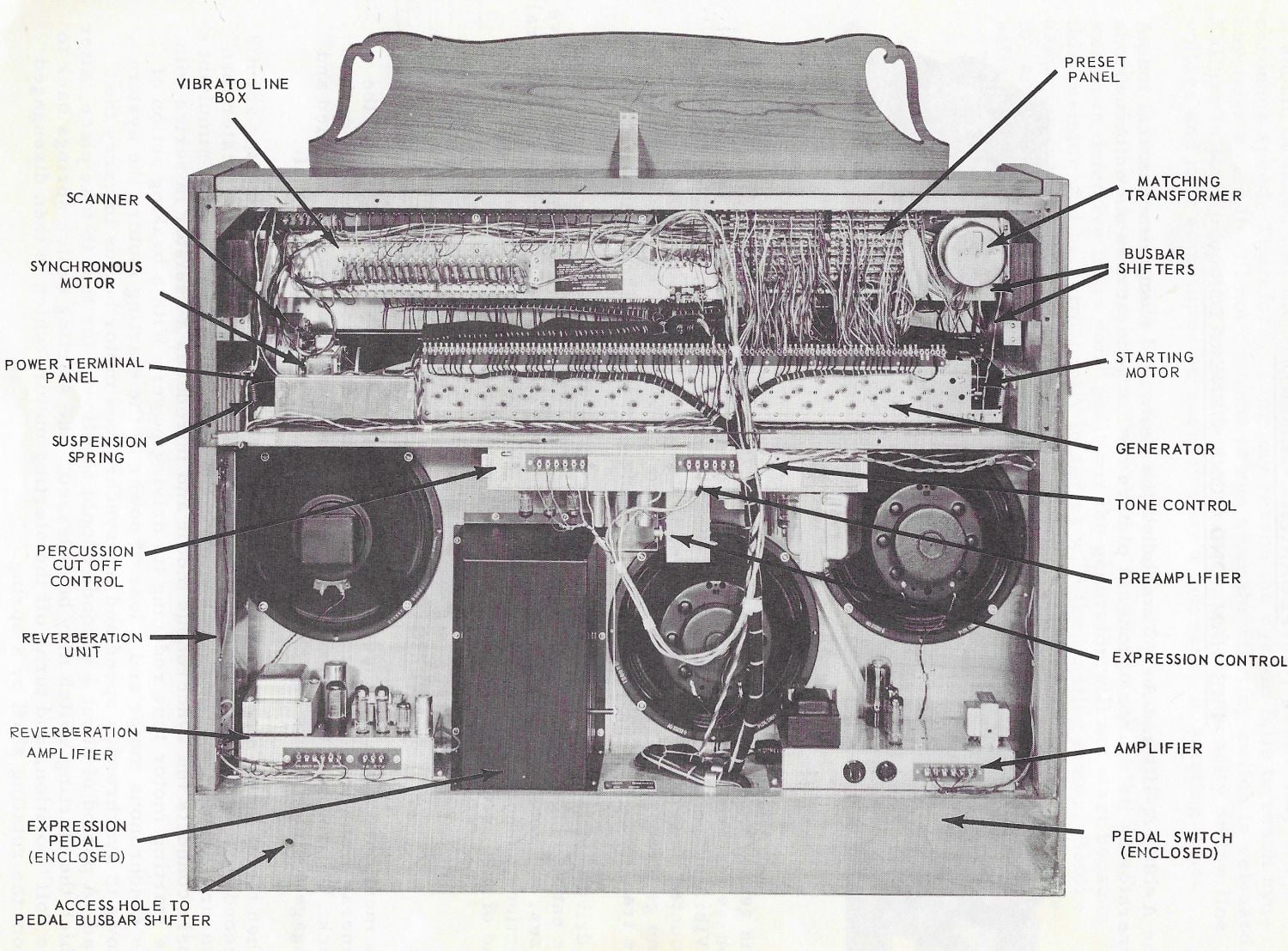
The Hammond organ is one of the most underestimated instruments for pop and rock. There is a reason why it has been around for almost a century now, as it has an unmistakable sound that can be heard in countless pieces of iconic music. From the classic Hammond B3 or C3 to the A100 series tonewheel organ, the Hammond organ covers a wide range of sounds that can be used in many genres. It’s a unique electro-mechanic instrument that produces a warm and organic tone, making it well-suited for pop and rock. The Hammond organ was popularized by artists such as Jimmy Smith, Stevie Wonder, Jackie Wilson, and The Doors. This instrument also opened up new possibilities for jazz musicians, as it enabled them to perform in clubs without needing to hire an entire band. Even today, many modern bands still use the Hammond organ in their songs, helping to create a unique sound. The Hammond organ is an incredibly versatile instrument that can be used to create various sounds and tones. Whether you’re looking for a classic vintage sound or something more modern, the Hammond organ is capable of providing both. Its ability to blend tones makes it ideal for recording and layering complex sounds, allowing producers to create something truly unique.

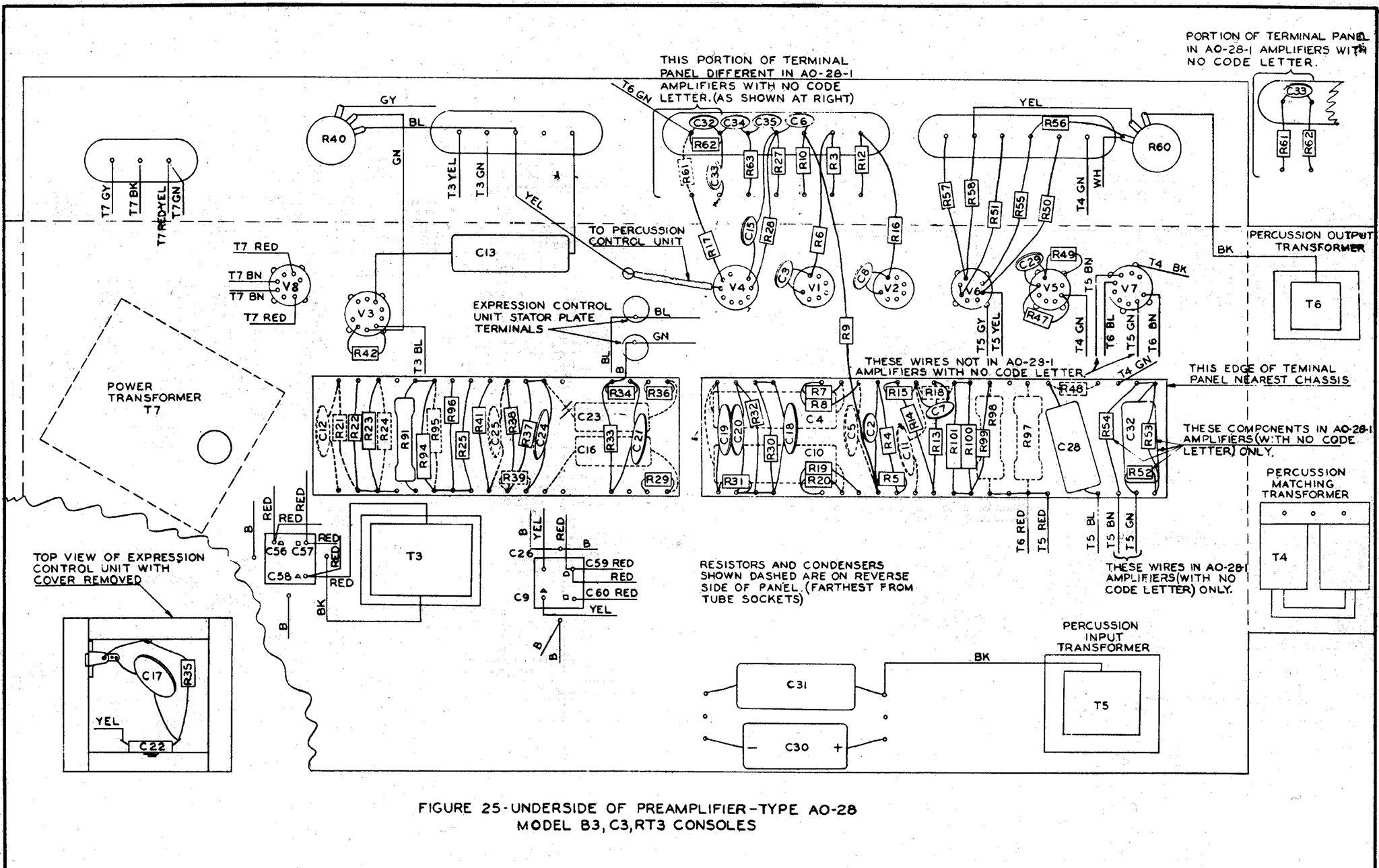
Schematic and parts list of the Hammond Preamp AO-28 (B3, C3)

Schematic of Hammond Preamp AO-28 Schematic of Hammond Preamp AO-28

AO-28 Capacitors

AmountCapacityTypeVoltageSchematic Nr.Mouser Part Nr.
125/25VElectrolytic25VC3075-TVA1205
230/25VElectrolytic25VC9, C2675-TVA1412
110/350VElectrolytic350VC5975-TVA1705
130/350VElectrolytic350VC5875-TVA1907
140/400VElectrolytic400VC5775-TVA1712
140/450VElectrolytic450VC5675-TVA1712
150/300VElectrolytic300VC6075-TVA1713
3100PFceramic500VC3,C8,C295982-15-500V100
1150PFceramic500VC355982-10-500V150
2220PFceramic500VC18, C205982-10-500V220
124PFceramic500VC75982-10-500V24
130PFceramic500VC65982-15-500V30
1390PFceramic500VC32**, C35*5982-15-500V390
139PFceramic500VC25982-15-500V39
151PFceramic500VC155982-15-500V50
1680PFceramic500VC175982-19-500V680
182PFceramic500VC245982-15-500V82
10.0015uFceramic500VC3475-715P600V0.0015
30.001uFceramic500VC25,C21,C3475-715P600V0.001
20.0022uFceramic500VC19,C33*75-715P600V0.0022
10.0033uFceramic500VC33**75-715P600V0.0033
20.0047uFFILM100VC11, C1275-715P600V0.0047
10.0082uFFILM1000VC3275-5GAD82
10.01uFFILM200VC575-715P200V0.01
20.033uFFILM400VC23,C1675-715P400V0.033
10.047uFFILM400VC2875-715P400V0.047
30.33uFFILM200VC4,C10,C3175-715P200V0.33
11.0uFFILM200VC1375-710P105X9400

AO-28 Resistors

AmountResistanceWattageTypeSubtypeSchematic Nr.Mouser part Nr.
647K0.5WMetalFilmR6,R16,R47,R52*,R53*,R54*273-47K-RC
21.2K0.5WCarbonComp.R42,R1730BJ500-1.2K
11.5M0.5WCarbonComp.R5730BJ500-1.5M
41.8M0.5WCarbonFilmR30,R32,R27,R4293-1.8M-RC
2100K0.5WMetalFilmR41,R62**273-100K-RC
1100 Ohms0.5WCarbonComp.R2530BJ500-100
310M0.25WCarbonFilmR5,R14,R18291-10M-RC
115M0.25WCarbonFilmR34291-15M-RC
11M0.5WMetalFilmR21273-1.0M-RC
12.2K0.5WCarbonComp.R4930BJ500-2.2K
22.2M0.5WCarbonComp.R7,R2030BJ500-2.2M
12.7M0.5WCarbonFilmR15293-2.7M-RC
1220K0.5WMetalFilmR62273-220K
122K0.5WCarbonComp.R5630BJ500-22K
122 Ohms0.5WCarbonComp.R5030BJ500-22
3270K0.5WMetalFilmR37,R3,R12273-270K-RC
13.3M0.5WCarbonFilmR35293-3.3M-RC
13.9M was 6.8M0.5WCarbonFilmR10293-6.8M-RC
2330K0.5WCarbonComp.R36,R2930BJ500-330K
1330K0.5WMetalFilmR39273-330K-RC
2390K0.5WMetalFilmR38,R63273-390K-RC
139K0.5WMetalFilmR61273-39K-RC
14.7K0.5WCarbonComp.R5130BJ500-4.7K
14.7M0.5WCarbonFilmR13293-4.7M-RC
14.7M0.5WCarbonComp.R5830BJ500-4.7M
2470K0.5WCarbonComp.R8,R1930BJ500-470K
1470K0.5WMetalFilmR48273-470K-RC
647K0.5WMetalFilmR6,R16,R47,R52*,R53*,R54*273-47K-RC
268K0.5WMetalFilmR31, R33273-68K-RC
1820K0.5WMetalFilmR9273-820K-RC
1820 Ohms0.5WCarbonComp.R2230BJ500-820
182K0.5WCarbonComp.R5530BJ500-82K
222K1WCeramicComp.R23, R24588-OX-22K
1180 Ohms5WCementR99280-CR5-180
22.7K5WCementR100, R101280-CR5-2.7K
34700 Ohms5WCementR94, R95, R96280-CR5-4.7K
1900 Ohms10WCementR91280-CR10-910
17500 Ohms10WCementR98280-CR10-5.0K

* These components are for AO-28-1 amplifiers with no code letter only
** These components are for H-AO-28-5 amplifiers

WordPress Wikiloops Plugin

Since I’m an avid Wikiloops user I created a plugin for WordPress that makes it easy to embed a track on Wikiloops on any WordPress powered website. Wikiloops.com is a meeting place for musicians and music lovers.
Those who play and record an instrument are invited to collaborate by adding to each others jam tracks – and everyone else is welcome to enjoy the free music streams, or to use our backing tracks as play-alongs for home practise.

The plugin leverages the capabilities of WordPress to embed objects automatically using the oEmbed protocol. Wikiloops is not yet part of the recognized list of oEmbed providers for WordPress, and the plugin does nothing more than registering Wikiloops as a known provider, so that the automatic embedding logic also works for Wikiloops track links after installing and activating the plugin. Once the plugin is activated, a link to a Wikiloops track can be added into any post or page by putting it on a separate line by itself, or by explicitly embedding it by putting the Wikiloops jam track link between embed tags.

Here’s an example: if you insert https://www.wikiloops.com/backingtrack-jam-67141.php on a line of its own, it will render like this:
https://www.wikiloops.com/backingtrack-jam-67141.php
Alternatively, you can embed it like this: [embed]https://www.wikiloops.com/backingtrack-jam-67141.php[/embed]

The plugin that makes this all possible is called Wikiloops-Track-Player, and can be downloaded from the WordPress Plugin Directory. To install the plugin you just need to put the plugin files into the wp-content/plugins directory. Once a plugin is installed, you may activate it or deactivate it from the Plugins menu in your WP administration panel. Removal is also straight-forward. Simply remove the directory for the plugin and it will be automatically deactivated.